Visuals
Futures in Figures
Charts about quantum computing and AI. Each one answers one question with real data, and comes as a post you can share.
Every number comes from the original source: a peer-reviewed paper, official statistics, a research group that publishes its method, or, for claims about a company's own hardware, that company's documents. Where a figure is a company's own claim, we say so. And where the source gives a range or says how sure it is, the chart shows that too, not just the headline.
01
Google says its quantum computer hit 99.99% accuracy. What does that mean?
On 15 October 2026 Google said its Willow quantum computer made one key building block, called a magic state, with 99.99% accuracy: at most 1 mistake in 10,000. To get there it checked every attempt and kept only the 8 in 100 that passed. It's a big step, but by Google's own estimate, breaking the codes that keep online banking and messages private would take 1,000 times fewer mistakes.
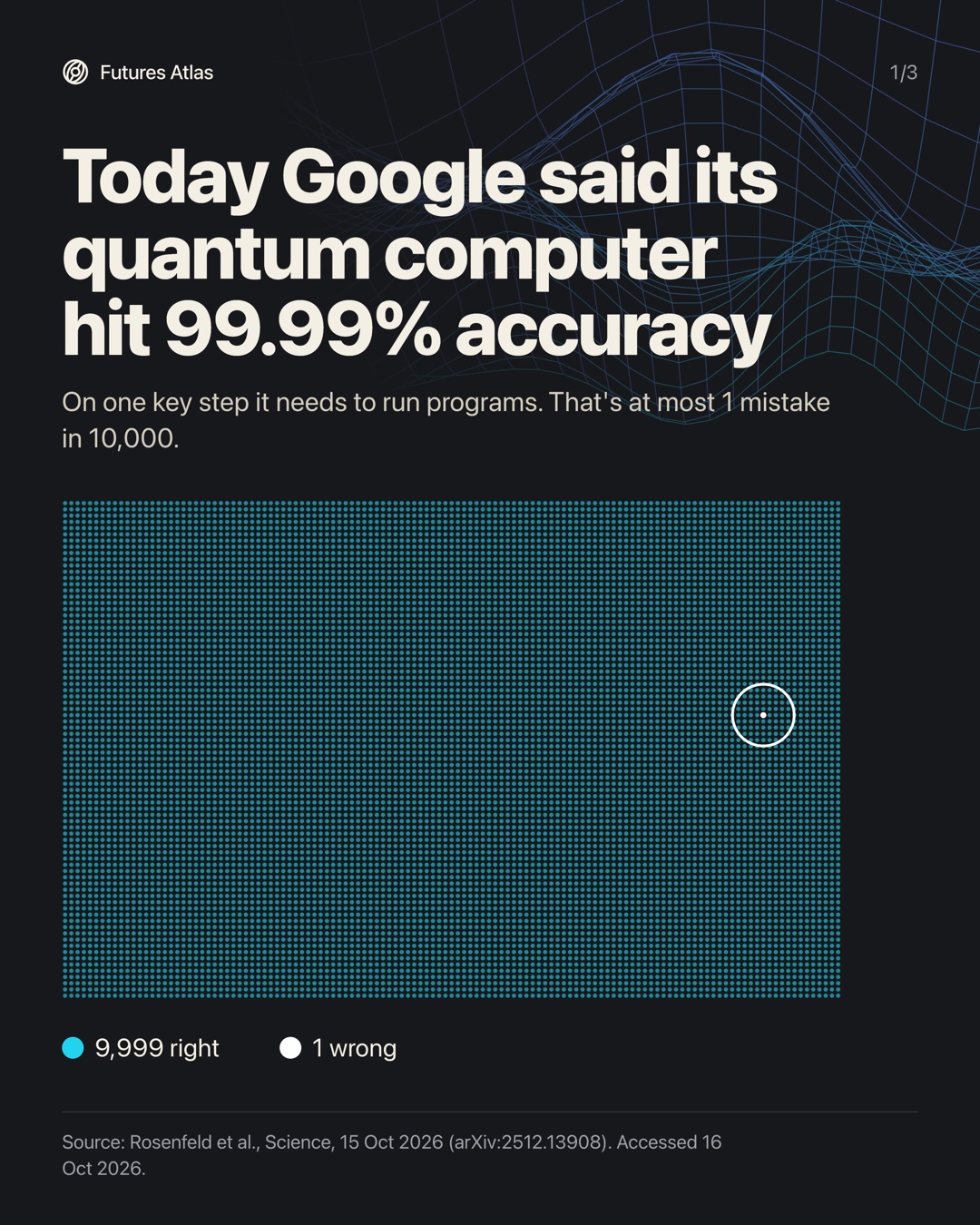
Keep in mind: The 99.99% is for this one step, not for everything the chip does: its basic two-qubit operations still go wrong about 3 times in 1,000 (see the error-rate chart below). It has only been shown at a small scale so far. The 1,000 times figure comes from one Google researcher's plan, which hasn't been peer-reviewed.
Social posts:Portrait videoLandscape videoStill image
Sources(2)
Method note · Chart data (CSV) · All accessed 16 October 2026
Rosenfeld, E., et al. (2026). Magic state cultivation on a superconducting quantum processor. Science, eaee7961. doi:10.1126/science.aee7961 (free preprint)
Peer-reviewed article. Supports: 99.99% accuracy, at most 1 mistake in 10,000 (state fidelity 0.9999(1)) (abstract); 8 in 100 attempts kept, 92 thrown away (abstract); Error cut 40 times by cultivation (abstract).
Gidney, C. (2025). How to factor 2048 bit RSA integers with less than a million noisy qubits. arXiv preprint arXiv:2505.15917. arxiv.org/abs/2505.15917
Preprint by a Google Quantum AI researcher, not peer-reviewed. Supports: 1 in 10 million: the error each magic state needs in this plan for breaking RSA-2048 (section Physical Costs, p. 20).
02
When could quantum computers break RSA encryption?
A Global Risk Institute survey asked 26 quantum experts how likely it is that a quantum computer could break RSA-2048, a common kind of encryption, within 5, 10, 15, 20 and 30 years. Only 1 put the odds at 70% or more within 5 years. Within 15 years, around 2040, 15 of the 26 did.
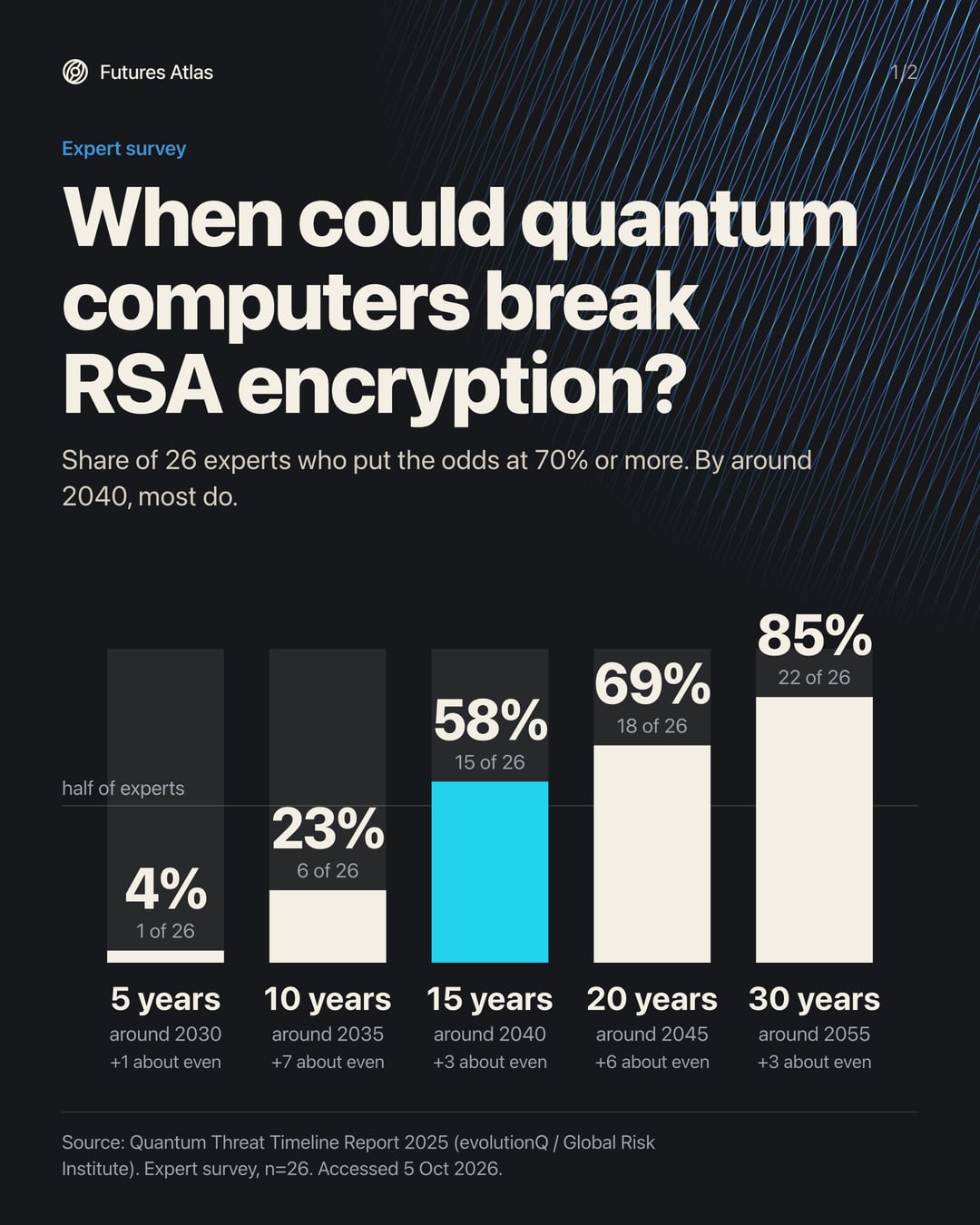
Keep in mind: These are expert opinions, not measurements: 26 invited experts, not a random sample. The survey's publisher, evolutionQ, sells quantum-safe security products.
Social posts:Portrait videoLandscape videoStill image
Sources(1)
Method note · Chart data (CSV) · All accessed 5 October 2026
Mosca, M., & Piani, M. (2026). Quantum Threat Timeline Report 2025. Global Risk Institute in Financial Services and evolutionQ Inc.. globalriskinstitute.org/publication/quantum-threat-timeline-report-2025b/ (PDF)
Expert survey report. Supports: Answers of the 26 experts at each time horizon (the bars) (Appendix A.4, p. 70); The question as asked (Appendix A.3, p. 68); Number of respondents, 26 (p. 19); The publisher's declaration of potential conflict of interest (p. 3).
03
Which quantum computers make the fewest errors?
Launches usually lead with the number of qubits, but a qubit is only useful if its operations work. These are the published error rates for nine machines. Trapped-ion machines come out lowest. Several of the biggest machines came without an average two-qubit error rate in the documents we used, and one, Caltech's 6,100-atom array, ran no two-qubit operations at all.
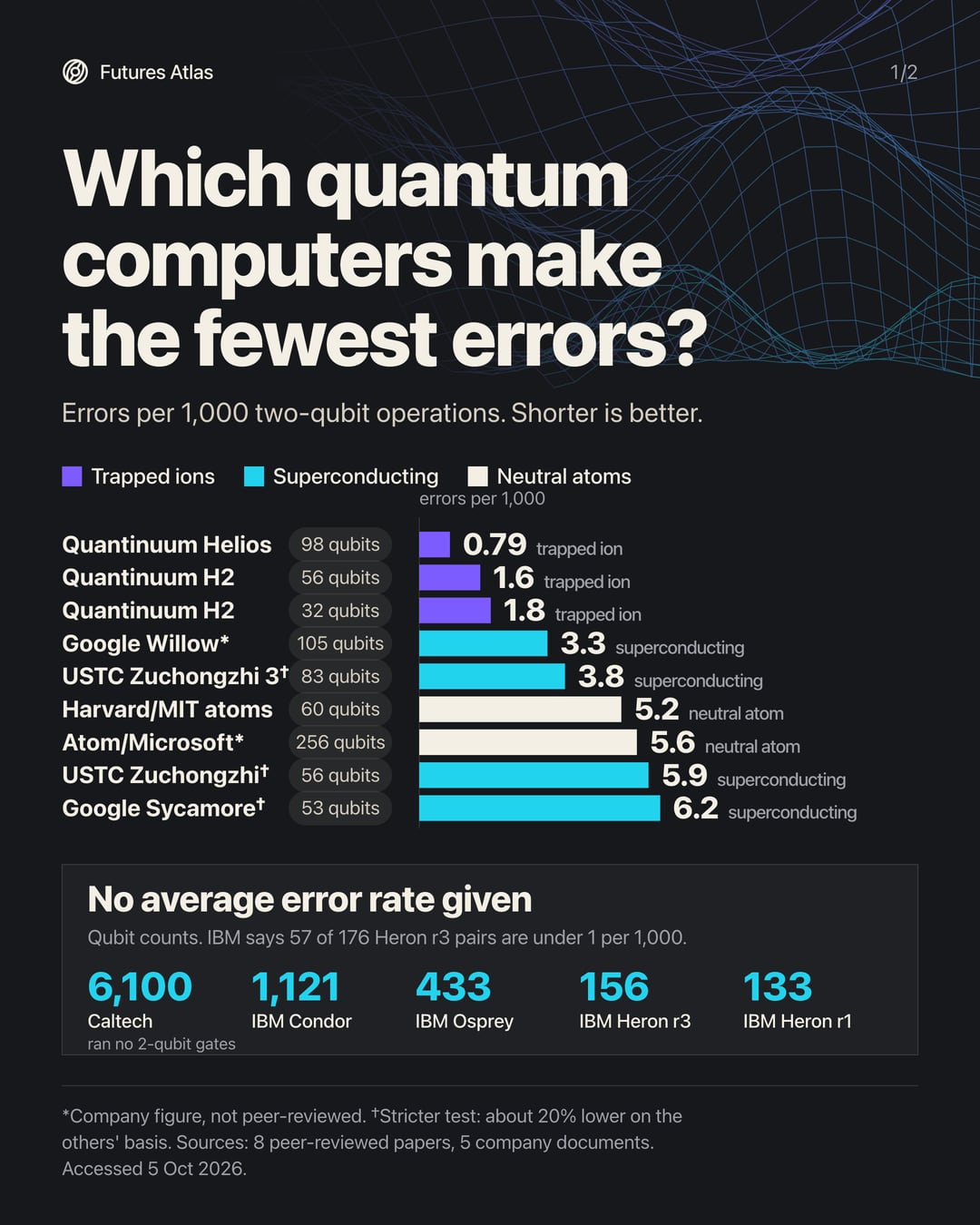
Keep in mind: Labs test in different ways, so treat close numbers as a tie. Google's 2019 chip and USTC's use a stricter test; on the same basis as the rest they'd read about 20% lower. Two figures are company claims, not peer-reviewed.
Social posts:Portrait videoLandscape videoStill image
Sources(15)
Method note · Chart data (CSV) · All accessed 5 October 2026
Arute, F., et al. (2019). Quantum supremacy using a programmable superconducting processor. Nature, 574, 505-510. doi:10.1038/s41586-019-1666-5
Peer-reviewed article. Supports: Google Sycamore: 53 qubits, 6.2 two-qubit errors per 1,000 (p. 507 text ("we find an average e2 of 0.62%") and Fig. 2a table (Simultaneous, Two-qubit e2)).
Wu, Y., et al. (2021). Strong Quantum Computational Advantage Using a Superconducting Quantum Processor. Physical Review Letters, 127, 180501. doi:10.1103/PhysRevLett.127.180501 (free preprint)
Peer-reviewed article. Supports: USTC Zuchongzhi: 56 qubits, 5.9 two-qubit errors per 1,000 (arXiv p. 2 (56 of 66 selected); p. 3, Fig. 2(c) caption ("of the 56 qubits and the 94 couplers") and text ("Average two-qubit gate pauli error e2 of our processor is 0.59% when all gates are applied simultaneously")).
IBM (2022). IBM Unveils 400 Qubit-Plus Quantum Processor and Next-Generation IBM Quantum System Two. IBM Newsroom. newsroom.ibm.com/2022-11-09-IBM-Unveils-400-Qubit-Plus-Quantum-Processor-and-Next-Generation-IBM-Quantum-System-Two
Company document. Supports: IBM Osprey: 433 qubits, no average two-qubit error given (Press release body).
Evered, S. J., et al. (2023). High-fidelity parallel entangling gates on a neutral-atom quantum computer. Nature, 622, 268-272. doi:10.1038/s41586-023-06481-y (free preprint)
Peer-reviewed article. Supports: Harvard/MIT atom array: 60 qubits, 5.2 two-qubit errors per 1,000 (arXiv Fig. 3d caption ("we measure a comparable fidelity of 99.48(2)% for the time-optimal gate implemented on 60 qubits in parallel")).
Moses, S. A., et al. (2023). A Race-Track Trapped-Ion Quantum Processor. Physical Review X, 13, 041052. doi:10.1103/PhysRevX.13.041052 (free preprint)
Peer-reviewed article. Supports: Quantinuum H2 (2023): 32 qubits, 1.8 two-qubit errors per 1,000 (Abstract ("an average two-qubit gate infidelity of 1.84(5)×10−3")).
IBM (2023). IBM Quantum roadmap 2033. IBM Quantum blog. www.ibm.com/quantum/blog/quantum-roadmap-2033
Company document. Supports: IBM Condor: 1,121 qubits, no average two-qubit error given (Section 'Breaking the 1,000-qubit barrier with Condor'); IBM Heron r1: 133 qubits, no average two-qubit error given (Section 'Access to the highest performing quantum processor: Heron').
Reichardt, B. W., et al. (2024). Fault-tolerant quantum computation with a neutral atom processor. arXiv preprint arXiv:2411.11822 (version 3). arxiv.org/abs/2411.11822
Company preprint, not peer-reviewed. Supports: Atom Computing/Microsoft: 256 qubits, 5.6 two-qubit errors per 1,000 (p. 3 table ("2Q Static IRB 0.56(15)%", loss + leakage 0.27(6)%); abstract (256 qubits, 24 and 28 logical)).
Google Quantum AI (2024). Willow Spec Sheet. Product specification sheet. quantumai.google/static/site-assets/downloads/willow-spec-sheet.pdf
Company document. Supports: Google Willow: 105 qubits, 3.3 two-qubit errors per 1,000 (p. 1, Quantum Error Correction (Chip 1), "Two-qubit gate error (mean, simultaneous) 0.33% ± 0.18% (CZ)").
Manetsch, H. J., et al. (2025). A tweezer array with 6,100 highly coherent atomic qubits. Nature, 647, 60-67. doi:10.1038/s41586-025-09641-4 (free preprint)
Peer-reviewed article. Supports: Caltech atom array: 6,100 qubits, no average two-qubit error given (Title and abstract).
DeCross, M., et al. (2025). Computational Power of Random Quantum Circuits in Arbitrary Geometries. Physical Review X, 15, 021052. doi:10.1103/PhysRevX.15.021052 (free preprint)
Peer-reviewed article. Supports: Quantinuum H2 (2024): 56 qubits, 1.6 two-qubit errors per 1,000 (arXiv p. 3, Table I (eps2Q, 2Q RB, 15.7(5) ×10−4); abstract gives 99.843(5)% fidelity).
Gao, D., et al. (2025). Establishing a New Benchmark in Quantum Computational Advantage with 105-qubit Zuchongzhi 3.0 Processor. Physical Review Letters, 134, 090601. doi:10.1103/PhysRevLett.134.090601 (free preprint)
Peer-reviewed article. Supports: USTC Zuchongzhi 3.0: 83 qubits, 3.8 two-qubit errors per 1,000 (arXiv p. 3, Fig. 2 caption ("selected 83 qubits") and Fig. 2b ("Average Pauli Error: 3.75‰")).
IBM (2025). Scaling for quantum advantage and beyond. IBM Quantum blog. www.ibm.com/quantum/blog/qdc-2025
Company document. Supports: IBM Heron r3: 156 qubits, no average two-qubit error given (Paragraph on Heron r3; qubit count from IBM docs processor-types page).
Ransford, A., et al. (2026). A 98-qubit trapped-ion quantum computer with all-to-all connectivity. Nature, 655, 81-86. doi:10.1038/s41586-026-10676-4
Peer-reviewed article. Supports: Quantinuum Helios: 98 qubits, 0.79 two-qubit errors per 1,000 (Abstract; p. 4 table (2Q gates, Average infidelity (2QRB) 7.9(2)); cycle benchmarking gives 8.1(2)).
Also consulted, not plotted
Bluvstein, D., et al. (2024). Logical quantum processor based on reconfigurable atom arrays. Nature, 626, 58-65. doi:10.1038/s41586-023-06927-3 (free preprint)
Peer-reviewed article. Checked for: Harvard/MIT/QuEra logical processor: 280 qubits, no average two-qubit error given (Abstract (280 physical, 48 logical); Methods p. 12 ("two-qubit gate fidelities in the range F = 99.3% − 99.5%")).
Google Quantum AI and Collaborators (2025). Quantum error correction below the surface code threshold. Nature, 638, 920-926. doi:10.1038/s41586-024-08449-y
Peer-reviewed article. Checked for: Google Willow error-correction result: 101 qubits, no average two-qubit error given (Abstract; Table S1 (neural network decoder, eps7 = (1.43 ± 0.03) × 10^-3)).
04
Training compute for the biggest AI models grew 4x a year
Training the biggest AI models took about four times more computing power each year between 2018 and May 2024 (Epoch AI's 90% range: 3.6x to 4.9x). The newest figures are the least certain, because labs often don't publish them.
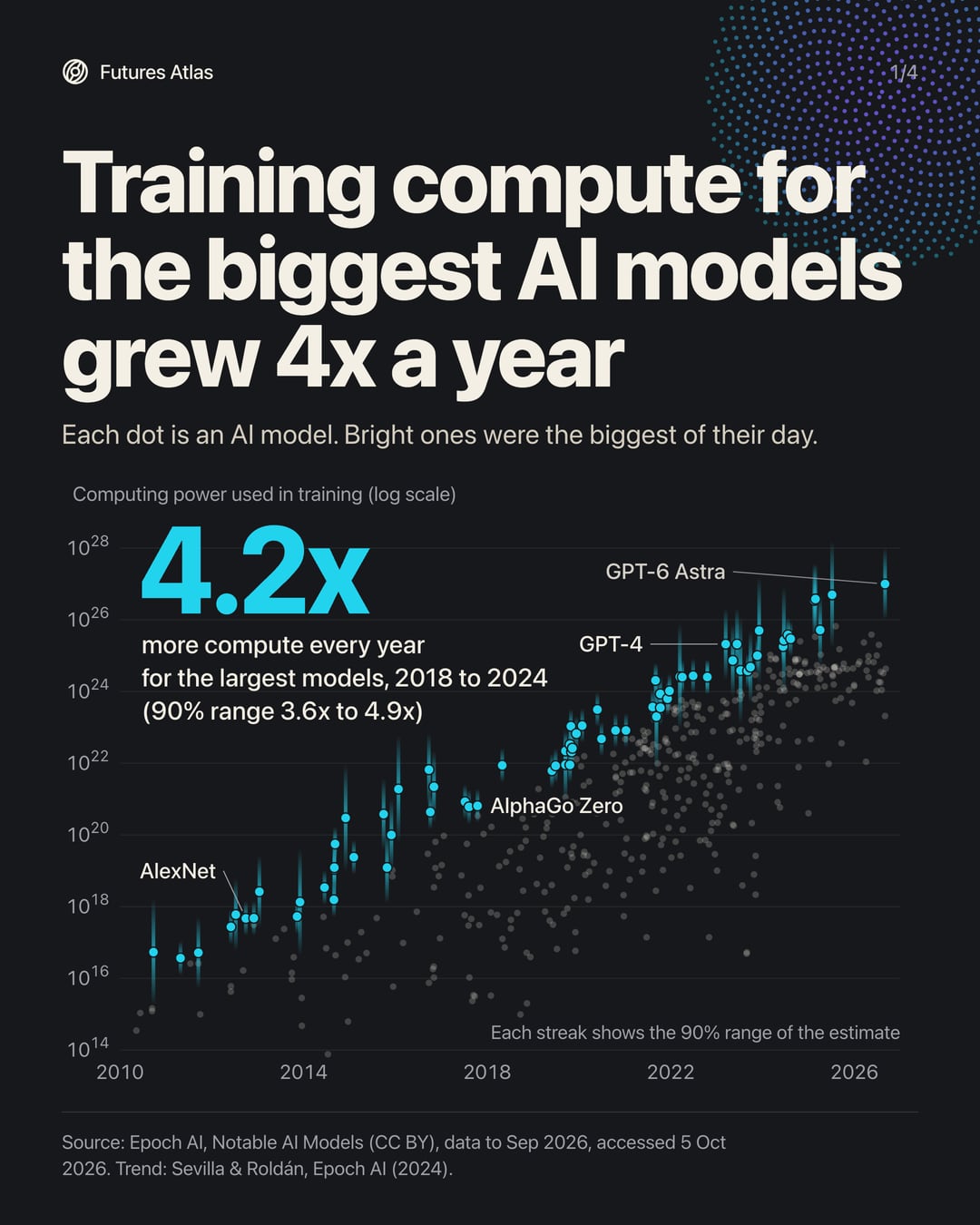
Keep in mind: Computing power isn't the same as how capable a model is. Each glowing streak shows the 90% range of an estimate.
Social posts:Portrait videoLandscape videoStill image
Sources(3)
Method note · Chart data (CSV) · All accessed 5 October 2026
Epoch AI (2026). Data on Notable AI Models. Dataset, CC BY licence (records to 9 September 2026). epoch.ai/data/notable-ai-models
Dataset. Supports: Training compute, date and confidence rating of every model (the dots) (notable_ai_models.csv, columns Training compute (FLOP), Publication date, Confidence, Frontier model).
Epoch AI (2026). AI models documentation: Estimation. Epoch AI. epoch.ai/data/ai-models-documentation/estimation
Dataset documentation. Supports: The 90% ranges behind each streak: confident ±3x, likely ±10x, speculative ±31x (section Estimating confidence).
Sevilla, J., & Roldán, E. (2024). Training compute of frontier AI models grows by 4-5x per year. Epoch AI. epoch.ai/blog/training-compute-of-frontier-ai-models-grows-by-4-5x-per-year
Research report. Supports: The 4.2x a year growth rate and its 90% range, 3.6x to 4.9x (frontier models, 2018 to May 2024) (section Frontier model growth has slowed, and now aligns with overall trends).
How these are made
- We start from the original data file or report, saved as we found it, and record where each number is in it.
- Where a number has to be copied out of a PDF, it's copied once into a transcription file with its page and a quote. A script does everything after that, so no number on a chart is typed in by hand.
- Each chart has a method note: the question, the sources, what we changed and what the chart doesn't show.
- Under each chart is its full source list: what each source supports and where in it the number is, with the chart's method note and its data as a CSV.